Friday, April 6, 2007

BOOK REVIEW: THE WIZARD OF MENLO PARK


By Randall Stross
Crown; 376pp; $24.95

The Good A perceptive account of the inventors' life--and surprisingly limited achievements. The Bad With dozens of Edison biographies, did we really need another one? The Bottom Line Noteworthy, especially for its debunking of Edison mythology.

Consolidated Edison, Commonwealth Edison, Southern California Edison: From the large number of corporate entities bearing the legendary inventor's name, one might deduce that Thomas Alva Edison became fabulously wealthy. Not so. In spite of his unrivaled fame, he was such a business failure that he once contemplated giving up inventing and came to depend on large loans from his friend Henry Ford. A son, Thomas Jr., was provoked to bitter complaint: "You should have been... a millionaire 10 times over if you knew how to handle your own achievements."

The lack of monetary success was strongly linked to two Edison habits: First, he repeatedly refocused on new projects before older ones reached commercial fruition. Then, relentlessly pursued by admirers, the Dean of Inventors proved easily distracted by celebrity. "He was glad to hold forth on any topic, such as the relationship of diet to national destiny," writes biographer Randall Stross. "Pontificating on demand...came to supplant the actual work of inventing."

Edison's fame and how he managed it is a primary theme in Stross' The Wizard of Menlo Park: How Thomas Alva Edison Invented the Modern World. The inventor has inspired dozens of biographies, including Neil Baldwin's much lauded 1995 Edison: Inventing the Century. But the new book, written by a columnist for The New York Times, is both enjoyable and perceptive. Especially noteworthy is its debunking of Edison mythology and its focus on the inventor's true—and surprisingly limited—achievements and failure to capitalize fully on even those.

Stross passes quickly over Edison's youth, including his early work as a telegraph operator. A decision in 1869 at age 22 to become a full-time inventor led him to seek to improve Alexander Graham Bell's rudimentary telephone. And in 1877, while tinkering with the phone, Edison had the idea for one of his greatest inventions: the phonograph, initially little more than a needle soldered to a phone diaphragm and set up to transfer voice vibrations onto wax paper.

That year, a demonstration of an early version of the apparatus to the editors of Scientific American ignited a frenzy. "This was stop-the-presses news," says Stross, describing how the journal delayed publication so it could squeeze in an illustrated story on the gizmo. "Edison would never again enjoy the sweetness of anonymous obscurity." Before long, he was transformed into a "mythic inventor hero."

However, in what would become a pattern, the publicity created consumer demand that went unmet. "Edison simply could not muster the focus to complete [the phonograph's] development," and he allowed the effort to lie fallow for 10 years. He flitted from project to project, promising a revolutionary hearing aid, a giant megaphone, and finally, in 1878, a reliable, long-burning incandescent lightbulb. (Several designs for such lights already existed, but none worked well.) Once more employing a coup de théâtre, Edison wowed members of the press with what Stross terms "sham demonstrations," briefly exhibiting far-from-perfect bulbs. The displays proved valuable as investor bait. In fact, Edison and his staff were a year away from developing a truly durable filament and three years away from commercial introduction of an electric light.

Over several years, his company labored to wire an entire Manhattan neighborhood. That project succeeded with a dramatic throwing of the switch in 1882. But there was no equally dramatic payoff: After a year, only 455 customers had signed up. Nor did Edison triumph with the phonograph, to which he returned in the late 1880s.

Edison's final noteworthy invention would be the kinetoscope, a motion picture machine he unveiled in 1891. It consisted of a wooden console with a peephole through which one viewed a very brief film. But the inventor saw little commercial potential. In Stross' view, the workaholic Edison persistently failed to see "the limitless business opportunities made possible by the commercialization of fun." In the end, a projection machine invented by others was marketed under his name, "the one asset that he possessed that remained valuable."

Edison applied for his final patent in 1931, the year of his death, bringing his personal total to 1,093. It was a seemingly vast accomplishment, even if most of the patents involved minor variations on previous ones. But his estate, first valued at $12 million, was ultimately determined to be worth only $1.5 million. (In contrast, Ford's net worth was estimated some years earlier at $2 billion.) It wasn't chicken feed—but hardly the riches that might have been won by the Man Who Defeated Darkness.

HOW DOCTORS THINK

By Jerome Groopman, M.D.
Houghton Mifflin; 307pp; $26

The Good A rare window into the doctor's mind.
The Bad Waits to the very end to give tips for patients.
The Bottom Line Numerous tales of misdiagnosis--and valuable lessons for everyone.

Over a period of 15 years a young woman named Anne Dodge saw doctor after doctor in a quest to overcome what was consistently diagnosed as an eating disorder. Following meals she experienced nausea and intense stomach pain, and sometimes she vomited. Nothing seemed to help—not therapy, not antidepressants, and certainly not the 3,000-calorie-a-day diet her internist prescribed. Her weight dropped to 82 pounds, and she was in danger of starving to death.

Dodge consulted as many as 30 doctors before she finally found one willing to consider that her problem might be something different from what others had diagnosed. He ran a battery of tests and spent hours talking with Dodge. Finally he hit on the solution: She had a rare autoimmune disease that she could control easily by eliminating gluten from her diet. Almost instantly, Dodge got her life back.

Health-care horror stories such as Dodge's are the backbone of How Doctors Think, by Dr. Jerome Groopman, a practicing physician and a professor at Harvard Medical School. Drawing partly on his own experience, Groopman delves deeply into the cognitive processes and prejudices that can drive physicians toward faulty diagnoses. Add in industry pressures, he argues, such as profit-hungry HMOs and aggressive pharmaceutical marketing practices, and you end up with a recipe for bad medical care. In a tone that grips but is never overwrought, Groopman provides a rare window into the doctor's exam room and passes along lessons valuable to all patients.

In chapter after chapter, Groopman methodically lays out the most common pitfalls for doctors, illustrating each with compelling real-life case studies. For example, there are "representativeness errors," which occur when a doctor's diagnosis is swayed by prototypes. An emergency-room physician misdiagnoses a fortysomething forest ranger's chest pain as a strained muscle because the patient looks too healthy to have heart problems. In fact, he has unstable angina and shows up in the ER the next day with a full-blown heart attack. Then there's "diagnosis momentum," the tendency for each health-care provider brought into a case to accept blindly the initial doctor's diagnosis. "Diagnosis momentum, like a boulder rolling down a mountain, gains enough force to crush anything in its way," Groopman writes. That's what happened to Dodge.

Groopman also makes a strong case against the health-care industry, which he believes is adding to the pressure on doctors to take cognitive shortcuts. As managed-care companies cut reimbursement rates, providers respond by cramming as many patients as they can into a day. Groopman writes of one Boston practice that instructed its physicians to cut each new-patient appointment from an hour to 40 minutes and to limit follow-ups to no more than 15 minutes. Also, they were told to fill out electronic templates as they talked to each patient in the hope that their tablet computers would help speed up the billing process. Meanwhile, the pharmaceutical industry bombards consumers with ads imploring them to "ask their doctors" about new drugs. Many physicians so fear losing business that they would rather give in to patients' drug demands than figure out if the requested medicine is the solution, Groopman says.

While Groopman sprinkles in examples of his own mistakes and those made by doctors who have treated him, the cases beyond his own practice provide the book's most eye-opening moments. He introduces readers to Rachel Stein, a rabbi who adopted a baby from Vietnam. When the child, named Shira, became desperately ill just days after arriving in the U.S., hospital physicians diagnosed her with severe combined immunodeficiency disorder (SCID), an inherited disease common in Asia. The only hope, they said, was a bone marrow transplant, a treatment so harsh it would put Shira's life at risk.

Stein spent hours researching SCID and corresponding with families affected by it. She became convinced that the problem was malnourishment, not SCID, and demanded the hospital run a battery of tests. Stein was right: Shira's immune system was normal, and proper feeding put her on the road to recovery. Because the baby fit the stereotype of the typical SCID patient, doctors overlooked the simpler diagnosis.

The most practical part of Groopman's book is the epilogue. There he encourages patients to challenge their doctors and even suggests the exact language to use. He recommends broad, open-ended questions such as "What else could it be?" or "Is there anything that doesn't fit?" After reading these tales of misdiagnoses and life-threatening decisions, patients will likely decide to take his advice.

BOOK REVIEW: THE STRATEGY PARADOX


Why Committing to Success Leads to Failure (And What to Do About It)
By Michael E. Raynor
Currency/Doubleday -- 303pp -- $27.50

The Good An insightful look at how the prerequisites of success are also the ingredients of failure.
The Bad At its worst, the book rationalizes bad business decisions as victims of bad luck or timing.
The Bottom Line The wide-ranging study of winners and losers provides penetrating insights.

Quick, which of these three companies doesn't fit with the other two: Apple (AAPL ), whose cutting-edge iPod line has made it a darling of Wall Street; IBM (IBM ), whose culture of quickly co-opting the innovations of others has helped it deliver decades of steady returns; or erstwhile media conglomerate Vivendi (V ) Universal, whose failure cost CEO Jean-Marie Messier his job and his shareholders billions in losses?

If you're an investor, you probably consider Vivendi to be the outlier. But according to Michael E. Raynor, author of The Strategy Paradox: Why Committing to Success Leads to Failure (and What to Do About It), there's actually a fine line between Apple's success and Vivendi's woes. Both took bold risks that seemed inherently logical at the time, but Apple's timing with the iPod simply proved to be better than Vivendi's early bet on the Internet--a predicament Raynor calls the strategy paradox. "The strategies that have the best chances of succeeding brilliantly are also the ones most exposed to the most debilitating kind of strategic uncertainty," writes Raynor, a distinguished fellow at Deloitte Research and co-author with Clayton Christensen of The Innovator's Solution. "Whatever the industry, firms that guess right and commit more vigorously to the strategy that fortune ultimately favors will defeat their competitors."

To discover what separates companies that excel from those that fall short, Raynor took a different tack from other management scholars. Instead of merely studying winning companies, in the mode of Jim Collins' classic Good to Great, Raynor also conducted postmortems of thousands of losers. This proved a valuable undertaking, providing many of the book's penetrating revelations.

The author was surprised to find that successful and failing companies shared so many similarities. (On that note, he includes case studies of winning approaches, such as those of Microsoft (MSFT ) and Johnson & Johnson (JNJ ), as well as perceived failures such as Vivendi, Canadian telecom giant BCE (BCE ), and Sony (SNE ), with its unsuccessful Betamax and MiniDisc technologies.) Most had made reasonable assumptions about the future of their businesses and had executed their strategies relatively well. In an unexpected number of instances, what separated the winners from the losers was either poor timing or unforeseeable changes in the landscape that played into the hands of some companies--and out of the hands of others. For instance, Raynor makes the provocative argument that Apple's success with the iPod was somewhat serendipitous: The popularity of Napster and other music-download sites created instant demand for digital-music devices while crushing the market for disc players like Sony's MiniDisc, which Raynor contends was a well-conceived product. Similarly, Vivendi's undoing was that its huge bets on the Internet came too early, and, Raynor argues, that Messier became too involved in minutiae at the expense of broader strategy.

To some degree, this all makes business sound like a crapshoot and explains why many companies opt for a strategy that minimizes failure but limits opportunities for explosive growth as well. But Raynor has created a governance structure that, he contends, allows leaders to forgo this traditional trade-off and achieve high returns even as they minimize the risks associated with growth. For a company to be able to adjust to unexpected shifts in business, he says, many traditional management roles must be redefined.

First, boards of directors should not be involved in strategy, he says. Rather, the role of a director should simply be to define the "strategic risk profile" for the company. "It is legitimately--and perhaps primarily--the board's role to consider carefully the trade-offs between risk and return implied by any strategy that management might propose," he writes.

Next, Raynor argues, CEOs should concentrate not on operations but on developing long-term strategies--or rather, a set of long-range strategic options. Lastly, Raynor favors creating a team of line managers who oversee the company's short-term operations and who don't worry about strategy.

Making these pieces fit together requires a plan, which Raynor provides as well. He suggests that senior-most executives map out every scenario they can imagine, as well as a menu of possible responses for each of these developments. Then, as the future unfolds, they determine which options are appropriate and take action. Overall, Raynor's approach requires more strategic planning than many companies are accustomed to. But if he's right, it could enable them to avoid becoming yet another statistic.

Thursday, March 8, 2007

BOOK REVIEWS: THE AVERAGED AMERICAN


THE AVERAGED AMERICAN
Harvard University Press; 398pp; $35

The Good A fascinating glimpse at the world of social science research and scientific polling.
The Bad The academic writing style is occasionally a tough slog.
The Bottom Line A rewarding look at the evolution of an information revolution.

With all of the data now available on consumers' wants and needs, it's hard to imagine that less than a century ago market research consisted of little more than knowing the number of widgets your business sold in Muncie. Then, in the years after World War I, commerce was revolutionized by the dawning of modern social science research and scientific polling techniques. A fascinating glimpse of the upheaval that forever altered the way Americans see themselves, sell products, and operate election campaigns may be found in The Averaged American: Surveys, Citizens, and the Making of a Mass Public by University of Pennsylvania historian Sarah E. Igo.

It was a rocky road to social transformation. In the early years of scientific research, Igo writes, it took a lot of work "to persuade business owners...that collecting information about their customers' buying habits was worthwhile." Many did not believe that citizens would answer prying questions about personal habits or political views from strangers knocking on their doors. And a large number of skeptics, she observes, did not "trust the assembled answers as either trustworthy or true."


Igo, a rising star among American historians, presents detailed analyses of three milestones in the emerging field of survey research: Robert and Helen Lynd's best-selling Middletown studies of 1929 and 1937, which dissected the lives of residents of an unnamed, average town in Middle America (Muncie, Ind.); the creation by George Gallup and Elmo Roper of the first public opinion polls in 1935; and Alfred Kinsey's shocking sexual-behavior reports of 1948 and 1953.

The key for the survey-research industry was defining "the average American." That's the everyman (yes, in those days, marketers wanted to appeal to "the man of the house") who will buy your products or vote for your candidate. As Newsweek noted in 1947, "a shadowy figure [is] beginning to emerge...American majority man."

But, as Igo wisely notes, the search for the average American intentionally excluded large swaths of the population. The Lynds' Middletown research excluded African Americans and immigrants, and Kinsey limited his sexual studies to Caucasians. Early polling often undersampled the poor, racial minorities, immigrants, Southerners, and others seen as less likely to purchase consumer goods or vote. "Even if [the portrait] was never particularly accurate or representative," Igo writes, the new typical Americans played "a vital role in consolidating the [concept of a] national public."

The world of surveys spawned businesses that were designed to explain these average Americans and "the public" to those who would buy the data, from politicians to companies. Business Week in 1934 called the Lynds' work "a godsend to marketers." Gallup saw similarities in how people think "from politics to toothpaste." Roper predicted that the science of polling would become "a veritable gold mine if we could learn fast enough how to use it in all of its ramifications."

It did become a gold mine for Roper, as he signed up companies that were eager to sell their products to average Americans. Among the first to embrace the new way of doing business: Ford Motor (F ), Standard Oil, the American Meat Institute, the National Broadcasting Co., RCA Victor, and the Spiegel catalog company.

As the polling business became more sophisticated, Gallup and others began to study gender, class, and geographical differences to help clients appeal to groups once "routinely ignored," including housewives, Southerners, and blue-collar workers. With the coming of the civil rights movement and the sexual revolution of the 1960s, "pollsters recalibrated their strong majoritarian frame, detecting new significance in how men and women, young and old, Latinos and Asian Americans assessed presidents and purchases differently." Niche markets and microtargeting became buzzwords on Madison Avenue.

At the dawn of the 21st century, survey research is continuing to evolve. Using state-of-the-art technology, pollsters examine brain scans to determine which product pitches or political platforms cause flashes of neural activity. The growth of Internet polling has raised debates over the scientific validity of Web-based survey techniques.

Polling, once considered a scandalous invasion of privacy, is now an accepted practice. More than 20% of Americans were polled at least once in the past year. As Igo aptly concludes, "we will continue to live in a world shaped by, and perceived through, survey data."

BOOK REVIEWS: TRUE NORTH


The Good A practical, inspiring examination of the executive experience.
The Bad
Some may be confused by the absence of a direct, prescribed path to becoming an ideal leader.
The Bottom Line
There's plenty of fodder to help readers figure things out for themselves.


When top executives sit down to write a book, the result is often a celebratory memoir or an upbeat treatise on how you can emulate their success. Bill George has chosen to produce neither, and readers are the luckier for it. Instead, the former Medtronic (MDT ) CEO and current Harvard Business School professor has teamed up with co-author Peter Sims to offer a practical, inspiring examination of the executive experience, True North: Discover Your Authentic Leadership. While the volume is a sequel to George's 2003 best-seller, Authentic Leadership, it easily stands alone as a guide to locating what the authors call "the internal compass that guides you successfully through life."


At the heart of True North is a series of interviews with 125 managers, from Novartis (NVS ) CEO Daniel Vasella to Palm (PALM ) co-founder Donna Dubinsky. George and Sims indulge in a few anecdotes that flatter their subjects. But they also get interviewees to talk about failures, emotional challenges, personal tragedies, regrets—in short, life events that knocked them off typical career paths. Taken together, the stories illustrate True North's thesis: that there is no single way to become an ideal leader. The volume is both memorable and perceptive.

True North has three parts. The first is an anecdote-rich section that describes what it means to be an "authentic leader" and examines how various people arrived at this status or lost their way. There's Kevin Sharer, who abandoned General Electric (GE ) for MCI, only to find that he was miserable and that Jack Welch wouldn't take him back. ("Hey, Kevin, forget you ever worked here," Welch told him.) Sharer learned patience and humility and went on to become chairman of Amgen (AMGN ). The key experience for Novartis' Vasella, in contrast, came from childhood: He endured years of illness and learned the value of compassion in health care.

The book's second section, which focuses on the five key facets of a leadership plan, is its most useful. First comes "knowing your authentic self," i.e., learning to be self-aware. This proved difficult for David Pottruck, a former CEO of Charles Schwab (SCHW ) who found that his long workdays and aggressiveness made colleagues resent and distrust him. His answer, on the job and in his third marriage, was to force himself to seek feedback on a regular basis. Next, after you attain a measure of self-awareness, you should focus on the values and principles that matter to you. David Gergen and Jon Huntsman, both of whom served in the Nixon White House and experienced the Watergate scandal up close, had to learn to draw ethical lines. Huntsman recalls that "an amoral atmosphere permeated the White House." The growing realization, highlighted by a request to entrap a politician, prompted him to leave.

A third step in the construction of a leadership plan is discovering what motivates you. The most successful leaders, the authors learn, rarely start out wanting to get rich. They are inspired to make a difference, to test their limits, to follow a passion. In many cases, they abandon secure posts for the unknown. Fourth in the authors' scheme is building a support team. Here, we read that many in Silicon Valley, including Palm's Dubinsky, were aided by Intuit (INTU ) Chairman Bill Campbell, whom George calls the "dean of mentoring." Howard Shultz of Starbucks (SBUX ) found inspiration in management guru Warren Bennis. Finally, you should try to forge what George and Sims call "an integrated life" that augments work with such things as family, friends, community service, exercise, church, and whatever else matters in your life.

True North's last section deals with empowering the people around you. The authors ask leaders—including many women (more than in any other part of the book)—to talk about the higher calling of their work. Avon Products' (AVP ) Andrea Jung explains that "what we do is elevate women in the community," while Anne Mulcahy of Xerox (XRX ) talks about trying to motivate personnel as the company struggled to stave off bankruptcy. As elsewhere in the book, this is no victory lap. At one point, Mulcahy recounts pulling over on a highway after a tough day, saying to herself: "I don't know where to go. I don't want to go home. There's just no place to go."

Most readers will relate to at least some of the subjects' struggles, whether they involve watching a sibling die or fighting to keep ego from getting in the way of results. These people come across as fallible, emotional, and, yes, authentic. A series of exercises at the end of each chapter may help readers evaluate their priorities and practices. While True North offers no simple answers, it provides plenty of fodder to help readers figure out for themselves how to become a leader.

Saturday, February 17, 2007

FIRING BACK


How Great Leaders Rebound After Career Disasters

Harvard Business School; 306pp; $29.95

The Good A smart roadmap to career recovery for deposed CEOs.
The Bad The prose is sometimes overwrought?and some material is a bit too familiar.
The Bottom Line A persuasive brief on the damage firings can cause.

April may be cruel, but January was hardly kind, either, at least to a few high-profile executives. On Jan. 31, Dell (DELL ) announced that founder Michael S. Dell would regain the CEO title, pushing out Kevin Rollins. Just nine days earlier, Gap (GPS ) said its embattled CEO, Paul Pressler, would be leaving the retailer. And on Jan. 3, Home Depot's board started the New Year off with a bang, bidding adieu to controversial Chief Executive Robert L. Nardelli.

Nardelli, of course, did walk out the door with a champagne-toast-worthy $210 million. But if that's not enough to cushion the blow, he, along with the many other managers who've lost their jobs as the rate of executive turnover has spiralled upward, may find further consolation in a new book by Jeffrey Sonnenfeld and Andrew Ward called Firing Back: How Great Leaders Rebound After Career Disasters. A sophisticated self-help guide for the fallen chief executive, Firing Back is a smart, if at times overwrought, analysis of the leader's road to recovery. Using accounts of tragic failures and triumphant returns, the authors get inside the mind of the humbled executive and provide a framework for rebuilding a reputation that will be of interest to any manager.

Sonnenfeld, a senior associate dean at the Yale School of Management, and Ward, a management professor at the University of Georgia, organize much of the book around a five-step plan for recovery. To begin with, they advise shamed leaders to fight the urge to flee to a remote enclave. Instead, they should recruit acquaintances to speak out carefully on their behalf. The rest of the book is structured around four barriers to recovering from a career disaster: societal, organizational, psychological, and reputational.

One of the most compelling chapters looks at the potentially reputation-damaging causes of a CEO's departure and how these could have an impact on any chance for a rebound. Sonnenfeld and Ward surveyed 45 elite executive recruiters on how different types of forced exits influence a former CEO's career opportunities. Interestingly, these "gatekeepers" said firings for cause, such as poor performance or improper conduct, make it even harder to get seats on boards than to get a chief executive spot at another company. (No word on how such negatives might affect prized private equity postings.)

The authors' examination of organizational barriers that result from company or industry cultures is equally engaging. They begin with a typology of cultures ranging from "baseball teams" to "academies," "clubs," and "fortresses." This provides a fresh perspective on one of the business world's squishiest subjects. Then Sonnenfeld and Ward describe how in industries marked, for example, by "baseball team" cultures, such as software or entertainment, a failure is easier to overcome, because these fields experience constant change and movement of executives between companies.

The book is at its best when it offers personal reflections from leaders, whether famous or anonymous, who have failed and started over. "The day I was fired, I was in tears," says David Neeleman, the founder and CEO of JetBlue Airways (JBLU ) who in 1994 was ousted from Southwest Airlines (LUV ), which had bought his first company, Morris Air. "I was angry and...determined that we would do something better than Southwest. With nine kids at home, my wife thought there was no need to get right back in."

Still, the volume would have benefited from even more such introspection. The authors often jump quickly from one famous name to the next, and the stories can feel repetitive. The authors also rely heavily on previously reported material.Examples such as Martha Stewart and Jeffrey Katzenberg feel overly familiar.

Some readers will cringe at the frequent use of the word "heroic" to describe CEOs' "mission" and "stature." Such grandiose terminology may flatter some chiefs, but it's a hard adjective to swallow in an era of scandal-tainted, lavishly compensated executives.

Still, even if the language is sometimes inflated, Firing Back makes a persuasive case about the psychological damage firings can cause, and it will resonate with readers whose careers have suffered setbacks. Many leaders' identities are closely intertwined with organizations they've run. And because their firings are often executed by a group of people (the board of directors), victims are less able to rationalize an ouster as due to the whim of an unfair manager. "Add to this the glare of publicity that surrounds the leader's public exit," the authors write, "and the realities...become inescapable." Fortunately, as Firing Back's authors outline, there is a road to recovery.

PAYBACK


Reaping the Rewards of Innovation

Harvard Business School Press -- 228pp -- $29.95

The Good A step-by-step program for innovation that actually makes money.
The Bad More how-to-instructions would help, along with more hard numbers.
The Bottom Line There's ample payback to be gained from reading Payback.


You're a pretty sharp executive. But maybe your company is suffering from slowing sales growth. Perhaps margins are getting squeezed. Or new competitors are stealing market share and talent. What do you do? Innovate, of course.

In Corporate America, acquisitions and cost-cutting are yesterday's strategies. Today, innovation is in. In a Boston Consulting Group Inc. poll of senior managers in 2006, 81% of chief executives listed innovation as one of the top three priorities at their companies. Further, 76% of CEOs told the BCG survey, done annually in partnership with BusinessWeek, that their corporate cultures foster innovation.

Despite their zeal, though, many companies come up short when it comes to innovation, observe veteran BCG consultants James P. Andrew and Harold L. Sirkin in Payback: Reaping the Rewards of Innovation. Typically, it's not because these companies lack smart ideas. It's that they don't manage to turn that winning concept into a winning product. "Most attempts at innovation fail to...generate enough payback," the pair write. "Payback means one thing--cash."

To better these returns, Andrew and Sirkin offer a step-by-step program for upper-level executives. Organized like a consultant's presentation--the authors are, after all, senior vice-presidents and directors at BCG--their advice is easy to grasp. Their book is also quick to read: You could probably breeze through the 22-page overview while the coach-class passengers file past to take their seats and be wrapping up the afterword before your flight from New York lands in Chicago.

The authors' main point is never to forget that innovation is only a means to make money. There are indirect benefits from innovation, of course, such as boosting morale and enhancing brand image. But unless innovation equals profit, it's not worth it. To see this plainly, Andrew and Sirkin urge executives to plot a cash curve. The chart measures four so-called S factors: startup costs, or prelaunch investments; speed, or development time to get to market; scale, or time to ramp up to peak volume; and support costs, which include marketing and cannibalization of earlier products.

Ideally, the curve follows the lifeline of Apple (AAPL )'s iPod. Certainly, design played a huge role in the product's dazzling success. Overlooked, argue the authors, was Apple's expertise in minimizing outlays and maximizing income. Apple kept its startup costs down, for example, by contracting out engineering work. As a result, Apple never had more than 50 employees on the iPod project team. By again turning to outside help, the company also hurried along the iPod's debut and ramp-up of production, hitting the market with ample supplies just before Christmas, 2001. All told, the authors estimate, Apple spent $10 million to develop the first iPod. Through 2005, they reckon, iPod-related sales came to more than $7 billion.

More often than not, however, the cash curve looks like the chart for Motorola (MOY )'s Iridium phone network. Motorola wisely put together a consortium of partners to share in the $5 billion it cost to start its new service, which included the launch of 66 low-orbit satellites. But there was no speed to market; it took 12 years to get from concept to reality. By then, mobile-phone networks had already won over many of Iridium's hoped-for customers, and at prices well below Iridium's. The venture went bankrupt in 1999.

"More than 30 years ago," say Andrew and Sirkin, "Bruce Henderson, founder of BCG, wrote, 'The majority of products in most companies are cash traps--they will absorb more forever than they will generate.' This is still true today."

Payback needs more how-to instructions. Yes, the cash curve is, as the authors say, "a case where a picture is worth more than a thousand words--it may be worth $100 million or more." But how to draw that curve when there are countless data points and every one is only a best guess? The book could also use more hard numbers. At LG Electronics, for instance, where the authors observed innovation teams, an executive related how many projects were under way (200) and how many were likely to have a big impact (10 to 20). But there are no figures on how much even one of LG's innovations cost or generated in sales or profit.

Based on its own cost curve, however, the book should put readers ahead. The up-front investment is minimal, and there's little time expended from start to finish. There's also ample payback in being reminded that innovation is likely to be no more of a fix-all than management fads of the past.

Wednesday, February 7, 2007

DREAMING IN CODE

Two Dozen Programmers, Three Years, 4,732 Bugs, and One Quest for Transcendent Software

By Scott Rosenberg
Crown -- 400pp -- $25.95

The Good A fascinating look inside one software-development project.
The Bad The project has not yet been completed--and the book seems a tad unfinished, too.
The Bottom Line A worthwhile examination of how the sausage gets made.

Rosenberg, co-founder of the online magazine Salon.com, knows his subject. He began tinkering with code in 1975 when, as a 15-year-old, he was given access to a New York University computer. Twenty-five years and many lines of code later, as managing editor of Salon.com, he experienced the frustrations of publishing a magazine with Web software. His tussles with programs made him want to better understand the process of software development. He decided to track the course of a single software project and tell its story.

For his target, Rosenberg chose Chandler, a project organized by PC industry pioneer Mitch Kapor. Kapor founded Lotus Development Corp. (IBM ), which published the first killer app of the PC era, the Lotus 1-2-3 spreadsheet. A true free spirit, Kapor dropped out of Lotus when it became big and bureaucratic, tried his hand at venture capital, and then settled in as a champion of online civil liberties and open-source software. Chandler, named after Raymond Chandler, the detective-novel author, began as an effort to invent a better electronic calendar--one that was easy to use, easy to share, and available on a variety of computers. Such a goal might seem simple and straightforward. Not so here: Although formal work on the project began in 2002, there is no end in sight. The "preview" version of Chandler is expected to be launched in the spring of 2007.

Why has development taken so long? Several reasons: Along the way, Kapor and his compatriots at the Open Source Applications Foundation decided to expand the functions in Chandler to include e-mail, task, and project management as well as group collaboration. This, in the parlance of the software industry, is called "feature creep" and is as common as it is irresistible. Second, technology changed, another common occurrence. Chandler started off as a program that would run on your PC and connect with others via peer-to-peer networking technology. As the project evolved, its designers added a server program to aid in the sharing of data and an online version called Scooby. And finally, figuring out how to build a new program, and then building it right, is just plain hard.

Rosenberg takes the reader inside the process to experience its joys and irritations. His scenes are vivid: In conference rooms in San Francisco and Belmont, Calif., we see celebrated software programmers of the PC era fill whiteboards with scribbling as they struggle over the large and small challenges involved in making something useful out of millions of zeros and ones. The cast of characters includes Andy Hertzfeld, a key member of the original Apple (AAPL ) Macintosh development team; Lou Montulli, a Web browser pioneer; and John Anderson, who managed software development for Steven P. Jobs's NeXT Software Inc. While these scenes may lack high drama, there's plenty of tension. As the project drags on, key programmers and managers quit in frustration, and Kapor's patience is frayed. Meanwhile, some journalists and even members of the open-source community write the project off as a lost cause.
Do you ever wonder why it took Microsoft Corp. more than five years to deliver Windows Vista, the latest version of its PC operating system? Are you baffled that some software products lack the one feature that would make them so much simpler? Have you had it with programs crashing? These are some of the mysteries of software, which is simultaneously an amazing boon for humankind and one of its scourges.

To better understand such matters, take a look at Scott Rosenberg's Dreaming in Code: Two Dozen Programmers, Three Years, 4,732 Bugs, and One Quest for Transcendent Software. The volume is a fascinating, yet ultimately frustrating, look inside one software-development


In a sense, Rosenberg bailed as well. Under deadline pressure from his publisher, he sat down to write the book even though the project had not been completed. "My story's threads," he says, "were beginning to vanish into a software time black hole." Rosenberg says that he felt he had experienced enough to give a true picture of how software is made. But to the reader who longs for resolution, that's not altogether satisfying.

Toward the end, the author waxes profound, comparing software creators to Sisyphus, the Greek hero condemned to endlessly roll a boulder up a mountain. However apt the analogy, Rosenberg does not believe software-making is an exercise in futility. There's pleasure in it, and eventually most software gets shipped. Someday, presumably, a final version of Chandler will, too.

CORONARY

A True Story of Medicine Gone Awry
By Stephen Klaidman
Scribner; 303pp; $25

The Good A gripping medical mystery--and a shocking tale of corporate greed.
The Bad Unfortunately, the end of the story is a bit of a letdown.
The Bottom Line Casts a beacon on the all-too-frequent association of medicine and the pursuit of profit.

In 2002 a Catholic priest named John Corapi had his heart checked out by Dr. Chae Hyun Moon. The celebrated cardiologist, who practiced at a Redding (Calif.) hospital owned by giant for-profit Tenet Healthcare Corp. (THC ), responded to Corapi's symptoms of exhaustion and shortness of breath with five of the scariest words in the English language: "You need a triple bypass."

Thus begins the tale of the priest, the doctor, and the multibillion-dollar hospital chain, recounted in penetrating detail in Coronary: A True Story of Medicine Gone Awry. Fortunately, as author Stephen Klaidman reports, Corapi then got opinions from three other doctors, all of whom said no surgery was needed since his arteries were completely healthy. The priest went to the FBI. An ensuing investigation and a raft of civil lawsuits turned up more than 600 patients who were allegedly subjected to unnecessary heart procedures by Moon and a colleague, Dr. Fidel Realyvasquez. The scandal, along with simultaneous revelations that Tenet may have improperly billed Medicare by as much as $760 million a year, brought what was the nation's second-largest hospital chain to its knees. And it provided forceful evidence that the drive for profits can put patients in mortal danger.


Klaidman, an ex-reporter at The New York Times and The Washington Post and a former health-policy researcher, deftly intertwines elements of a medical mystery story with disturbing details about corporate greed. So profit-focused was Tenet, Klaidman discovered, that it required each hospital CFO to submit monthly reports on individual doctors' contributions to the bottom line. Redding Medical Center (RMC), home base to Moon and Realyvasquez, was a cash cow, generating $3,181 in revenue per patient per day, or twice Tenet's average. What's more, in 2002 its pretax income soared 31%, to $93.6 million. Drawing on medical records, depositions, FBI files, and interviews, Klaidman brings this culture to life, offering vivid dialogue and scene-setting.

A novelist would be hard-pressed to invent more outsize characters. Colleagues and other doctors portray Moon and Realyvasquez as egomaniacs who battled with each other and didn't win many friends among their patients, either. Realyvasquez was so foul-mouthed that RMC's CEO felt compelled to report him to Tenet's top brass. And more than once, a nurse recalled, Moon rattled his terrified patients by remarking: "I'm going to save your life. This is your lucky day." Then there's the whistleblowing priest, whose story provides one of the book's most fascinating chapters. A former accountant and real estate broker, Corapi got caught up in the Los Angeles drug scene in the 1970s, even attending the party where comedian John Belushi was on the night he died. Homeless and strung out on cocaine, Corapi decided to turn his life around and entered the priesthood at age 37.

Equally compelling are Klaidman's stories of patients who weren't so lucky. There was the ex-railroad worker who had lost part of one leg in a boxcar accident and had to have a vein taken from his good leg for a quadruple bypass. Then there was the grandmother who suffered debilitating strokes after her heart surgery. Later, physicians hired by a personal-injury lawyer determined that both patients' procedures were unnecessary.

In the midst of such gripping drama, Klaidman never forgets that, at its core, this is a tale of a company that seems to have cracked under pressure from Wall Street to continually boost profits. Just one day before the FBI raided RMC to collect evidence on Moon and Realyvasquez, an analyst reported that Tenet had been raising prices in order to benefit from the extra fees Medicare paid for "outliers"—patients who have extraordinarily expensive procedures such as those performed by RMC's cardiac unit. The coincidence is not lost on Klaidman: He says RMC was near the top of the list of outlier abusers, generating 59% of its pretax income from the fees.

Coronary's only failing may be the ending of its story. After hearing so many shocking tales, we expect the hand of justice to crush Moon and Realyvasquez. In fact, the U.S. Justice Dept. did not bring criminal charges against the pair. They and Tenet settled the civil cases for $450 million. Moon and Realyvasquez left medicine. Tenet also paid the U.S. government $900 million to settle claims regarding alleged improper financial activities. The company, now a shadow of its former self, "has taken many steps to improve clinical quality and compliance oversight," says a Tenet spokesman.

Klaidman succeeds at casting a light on the all-too-frequent association of medicine and profit-mongering. And he leaves readers with a stark and enduring lesson: Never underestimate the importance of a second opinion.

Tuesday, February 6, 2007

THE REAL TOY STORY


THE REAL TOY STORY
Inside the Ruthless Battle for
America's Youngest Consumers
By Eric Clark
Free Press; 259 pp; $26

The Good A colorful look at how giant toy corporations duke it out.
The Bad Billed as a startling expose, it won't surprise many adults.
The Bottom Line A worthwhile overview of the $22 billion toy business and the challenges it faces.

Each February, thousands of toy manufacturers, retailers, promoters, and dreamers descend on New York for the industry's mammoth Toy Fair. Many come lugging new toy samples—some no more than models in Styrofoam and glue—that they hope will make it to retailers' shelves and little kids' hands by Christmas. It's an inspiring and amusing phenomenon: There's something incredibly cute about grown-ups trying to pitch the next Cabbage Patch Kids or Easy-Bake Oven. But, alas, in Toyland, as in almost every industry, dark forces are at work.

Those dark forces are what British investigative reporter Eric Clark seeks to expose in The Real Toy Story: Inside the Ruthless Battle for America's Youngest Consumers, billed by his publisher as a Fast Food Nation for the Beanie Baby biz. Clark describes a world in which giant corporations, struggling to cope with retail consolidation and children's waning interest in traditional toys, slug it out in a global version of Rock'em Sock'em Robots. Foremost among the toymakers' heinous deeds is the exploitation of low-cost workers in China. On top of that, they employ TV, the Internet, and even slumber parties seeded with products to turn children into toy-hungry tyrants, destined to nag their parents into purchasing the latest It'll Keep Them Busy for 20 More Minutes Elmo.

My problem is this: Does anyone not know these things? Isn't all this a bit like telling parents there is no Santa Claus?

Still, Clark's volume provides a colorful overview of the $22 billion toy business and the challenges it faces. For one thing, kids are getting older faster, as the industry expression goes. They very quickly jump from dolls and toy trucks to computers, iPods, and video games. That's why toy sales have been lagging for the past few years. To make matters worse, discounters Wal-Mart, (WMT ) Target (TGT ), and Kmart (SHLD ) have come to control the lion's share of the business, while retailers such as Toys R' Us and FAO Schwarz are struggling. Pricing pressure brought by these big merchants forces large toymakers to seek out lower-cost labor overseas. Meanwhile, small producers find it ever tougher to get distribution.

Clark offers a whirlwind history of toy advertising on TV. That begins with two critical events from 1955: the first televised toy commercial, for Hasbro's (HAS ) Mr. Potato Head, and the decision by Mattel's Elliot and Ruth Handler to pony up their company's entire $500,000 net worth to purchase a year of advertising on a new ABC show called The Mickey Mouse Club. The emphasis on TV advertising turned out to be only the first step in toymakers' evolution into entertainment companies. In 1984, Hasbro transformed the industry with Transformers—a line of shape-changing robots that simultaneously appeared in the U.S. as toys, comic books, and an animated TV program. Today, royalties from toy sales provide critical funding for even public TV shows such as Sesame Street. Mattel, (MAT ) meanwhile, releases feature-length DVDs starring Barbie.

In his final chapter, Clark visits China, or as he calls it, Santa's Sweatshop. Rather than cite the experiences of real employees, Clark only produces a composite, whom he calls Li Mei. The 18-year-old factory worker in China's Guangdong province suffers from a range of workplace disorders, including open cuts on her hands and rashes from the toxic chemicals she is exposed to at the plant. Just to obtain her job, which pays about $1 a day, she had to bribe a supervisor. Workers like Li Mei sleep, sometimes two to a bed, in company-owned dormitories. They get charged extra for meals, physicals, employee ID cards, and even toilet paper. To meet quotas as high as 4,000 dolls a day, Li Mei must work night shifts, where she gets fined if she dozes off.

Working conditions in China can be reprehensible, and Clark is to be applauded for reminding the world of that fact. But what's likely to stay with readers are Clark's anecdotes about how many well-known toys and games got their start. Did you know that Lincoln Logs were created by architect Frank Lloyd Wright's son, who was inspired by his father's design for Tokyo's Imperial Hotel? Or that Play-Doh was developed first as a cleaning compound for wallpaper? Slinky, it turns out, was the brainchild of a naval engineer, who was inspired by a large torsion spring that he saw on a ship.

The present-day counterparts of such inventors represent the strong suit that the toy business will rely on to survive the powerful waves of consolidation, globalization, and competition from consumer electronics. And they'll all be out at Toy Fair in February—glue guns in hand.

BOEING VERSUS AIRBUS


The Good An instructive look at the commercial airplane industry by a knowledgeable observer.
The Bad The author takes on too much, causing the reporting to seem thin at times.
The Bottom Line A valuable overview of one of the most fascinating and complex stories in business.

It looked bleak for Boeing (BA ) at the end of 2004. In a stunning reversal, Air Berlin, a longtime Boeing customer, announced a deal to buy more than 100 jets from chief rival Airbus. The German order was one of many that favored Airbus that year. Worse, sales of Boeing's new fuel-sipping jet, the 787 Dreamliner, were tepid. Boeing CEO Harry Stonecipher was furious. He ordered the top sales chief fired and even threatened to oust Alan Mulally, then head of Boeing's commercial airplane division. Airline execs complained that Boeing was taking them for granted.

In mid-January of 2005, Airbus turned up the pressure, rolling out its gleaming new A380 superjumbo jet and securing its first order for the plane from an airline in China, the world's most important commercial aircraft market. But just as it seemed the handwriting was on the wall for the U.S. company, "fortune pivoted abruptly in Boeing's direction," writes John Newhouse. Boeing started winning some "bitterly hard-fought campaigns" pitting the 787 against the new Airbus A350. Thus began a Boeing revival that continues to this day.

In Boeing Versus Airbus: The Inside Story of the Greatest International Competition in Business, Newhouse offers an instructive look at the two airplane companies during the latter half of the 1990s and into the new century--a period when the momentum in their rivalry was swinging to Airbus and then swiftly turned back to Boeing. The author, a former writer at The New Yorker and author of an influential 1982 volume on the commercial airplane industry, The Sporty Game, depicts the U.S. company as struggling with a variety of issues in the late 1990s, particularly that of absorbing new acquisitions and managing a much enlarged company. But he also captures the more recent decline of Airbus and the story behind the troubles plaguing its A380. Although the book suffers somewhat from thin reporting and occasional generalizations, it represents a valuable overview of one of the most fascinating and complex stories in business.

The rivalry intensified in 1999, when Airbus passed Boeing in total sales and, with much fanfare, announced the launch of the A380. Boeing, meanwhile, was making a rather tepid effort to protect its eroding market share. It was struggling with self-inflicted production meltdowns and had become conservative and unwilling to launch new models. Boeing's 220-passenger 787 Dreamliner, the first large carbon-fiber-based commercial jet, was no more than a glint in an engineer's eye. Meanwhile, Boeing's senior execs were preoccupied with absorbing the defense and space acquisitions of Rockwell Aerospace, McDonnell Douglas, and Hughes Space & Communications. The ensuing culture clash was bitterly dividing the company.

Newhouse offers an engrossing behind-the-scenes look at the 1997 merger talks between Boeing and McDonnell Douglas. He provides considerable detail on how McDonnell outfoxed Boeing. For example, both boards authorized Boeing's then-CEO Philip M. Condit and then-McDonnell Douglas CEO Harry Stonecipher to meet and narrow their key differences at a plush Seattle hotel. After forty-five minutes, the two agreed on everything, including the merger price. But Boeing execs criticized Condit for not having a lawyer present, rightly fearing that Stonecipher had won more concessions. Newhouse quotes former senior Boeing exec C. Gerald King, one of the architects of the merger, as saying that "the Boeing side wanted to have as little to do as possible with Stonecipher," who was viewed as prone to milk assets and overly reluctant to invest in new products. The deal had the unforeseen consequence of making Stonecipher the second-most-powerful exec at the new Boeing, positioning him to assume the No. 1 spot when Condit resigned in 2003.

Another absorbing chapter focuses on Jean Pierson, the legendary former CEO of Airbus during its most successful growth spurt. The section draws upon one of the few extensive interviews the Frenchman has granted since his 1998 retirement, in which, among other things, Pierson recounts various sales battles. In 1997, for example, he was engaged in negotiations with Steve Wolfe, then the CEO of us Airways (LLC ), over the purchase of 130 A320 aircraft. At the very end, Wolfe demanded an additional 5% discount. In response, Pierson recalls, he began slowly lowering his trousers, saying: "I have nothing more to give."

Such fly-on-the-wall stories are among the strengths of Boeing Versus Airbus. Newhouse also is particularly good in describing the role of government in the aircraft industry. On the other hand, he tries to cover too much ground. All the same, Boeing Versus Airbus is a must-read for anyone looking for a glimpse into the white-knuckled world of the commercial airplane business.

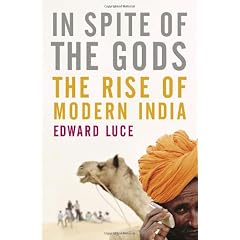
IN SPITE OF THE GODS


IN SPITE OF THE GODS
The Strange Rise of Modern India

By Edward Luce
Doubleday; 383pp; $26

The Good A graphic, and deeply personal, portrayal of India today.
The Bad The author's prescriptions for change are hardly profound.
The Bottom Line A balanced chronicle of the often contradictory dynamics that are driving the country.

James Paul, 29, is emblematic of India's new dynamism. The son of lower-middle-class Christian schoolteachers from the southern state of Kerala, he is a graduate of the elite Indian Institute of Technology in Mumbai. His parents were forced to take out a loan to fund his $120-per-term tuition. It paid off: Paul now manages a 1,500-person business unit at Bangalore software giant InfoSys Technologies Ltd. (INFY ), where he was hired in 1998. His salary has jumped tenfold in a decade, to $50,000, a huge sum given the area's low cost of living.

India, as anyone who hasn't had his eyeballs permanently affixed to a Sony PlayStation knows, is an economic juggernaut. In 2005, while launching its first bank in the country, General Electric Co. (GE ) projected double-digit revenue growth in Indian banking far into the future. "No one blinked," observes author Edward Luce. But weighing against GE's glowing assessment is the nation's widespread poverty: More than 300 million people live in squalor in the country's 680,000 villages, where both land and water are in short supply. Many homes are made with buffalo dung and feature charcoal hearths whose fumes worsen the symptoms of a prevalent disease, tuberculosis. Only 65% of the population can read, and in the villages that number falls as low as 33%. (China's literacy rate is 90%.)

source: businessweek

Friday, January 5, 2007

A Treasury of Boxing Reportage


A FEW years back I asked Angelo Dundee, Muhammad Ali’s trainer, for some advice on breaking into the scribbling side of boxing. As though he were offering a fighter instruction, the legendary cornerman placed his hands on my shoulders and began his counsel with “Son, boxing writers are a dying breed.”

In the early to mid-20th century, when boxing was second only to baseball in popularity, magazines and newspapers hired writers for the primary purpose of covering the fights. No more. Though well known as the author of “What Makes Sammy Run?” and the screenwriter for “On the Waterfront,” Budd Schulberg must certainly be reckoned a card-carrying member of that old guild of boxing scribes.

The son of a Hollywood mogul with a passion for pugilism, Schulberg has been ringside for fights that stretch the timeline from the Benny Leonard era to the Lennox Lewis years. This collection of previously published reports and commentaries for magazines like Sports Illustrated (where he was the first boxing editor), Collier’s and Esquire brims with such fascinating stories as the time Rocky Marciano confided to Schulberg alone that he was going to retire after his fight with Archie Moore. Or again, Schulberg recalls witnessing a side of Ali that very few have ever glimpsed. He was riding shotgun with the champ on the way to Madison Square Garden for the first encounter with Joe Frazier. An uncharacteristically diffident Ali was peppering Dundee with rhetorical questions intended to give a bounce to his confidence. Then Ali turned silent and put his head back. When they arrived at the Garden, “Ali went through a night-and-day personality change. ‘I am the greatest!’ he shouted. ‘The Greatest!’ Whatever back-seat doubts he had had in the limo were gone now as he went on shouting, strutting in for his ‘High Noon’ shootout with his most dangerous opponent.”

In the 1950s, Schulberg entered into the world that he spent most of his life describing. He turned the barn of his New Hope, Pa., farm into a boxing stable. Archie McBride, a potential Golden Gloves candidate from nearby Trenton, came through the door, and the next thing you knew, the rookie boxing manager had a heavyweight contender on his hands. Listening to Schulberg juggle his mother-hen-like worries about McBride with his efforts to bring “On the Waterfront” to the screen will entertain readers, as will the essay that concludes the collection — a monograph-length memoir of Mike Jacobs, the promoter who began by buying tickets for a scalper at Madison Square Garden and ended up controlling that boxing mecca. Schulberg leaves no doubt that Jacobs could have given Don King lessons in chicanery.

The British writer Hugh McIlvanney, who contributes an introduction to this book, once aptly described boxing as “the hardest game.” With the terrible risks and scant prospects for payoffs, professional pugilists live on the edge. The sport requires enormous courage, and Schulberg’s offerings resonate with a profound respect and affection for the bruising artists that is rare among reporters who have never bent through the ropes to a chorus of howls from a bloodthirsty throng.

The prose of boxing writers who worked before the dominance of television was punchier than the more subdued and wry tones of today’s sports sophisticates. Schulberg’s brash style and sometimes comedic choice of adjectives are refreshingly revenant . A few of the columns that make up the middle rounds of this work will seem outdated to ardent boxing fans. Nevertheless, the essays that take a toehold in the ’40s and ’50s will prove essential reading for all serious students of the sweet science.

Gordon Marino, a professor in the College of Health and Human Performance at the University of Florida, is at work on a boxing book.

'Mothers and Sons: Stories'


Colm Toibin’s first book of stories begins with a man on an upper balcony, looking out on a city that is a “great emptiness.” The image is a haunting one, if only because Toibin’s last, much acclaimed novel, “The Master,” was preoccupied with a man watching the world from an upstairs window, a secret sharer, relishing the power of being an observer while terrified, deep down, of being observed himself. That man was Henry James. In “The Use of Reason,” the opening story in Toibin’s beautiful and echoing collection, the man in question is a high-end thief in contemporary Ireland who, when not doing violence to others with calm ferocity, is picking off a Gainsborough and Rembrandt’s “Portrait of an Old Woman,” only to bury his treasure in the hills.

The thief is, of course, a master of his craft. He has a shrewd gift for assessing people and a solitary, meditative nature; he doesn’t mind being in jail because he likes being alone with his routine, his secrets, his talent for giving nothing away and for remaking everything within. He is also a supple reader of the world; emerging from incarceration, he had the feeling “that behind everything lay something else, a hidden motive perhaps, or something unimaginable and dark, that a person was merely a disguise for another person, that something said was merely a code for something else.”

He would find nothing to contradict that impression in the half-lit, stealthy, lamenting stories that follow. Toibin establishes his command over his materials early on, and the clenched, sepulchral tone never lets up. As “The Use of Reason” moves toward its conclusion, we meet the criminal’s mother and suddenly see another reason why he might feel guilty and alone. More than that, we see from whom he may have inherited his gifts for secrecy and treachery. The atmosphere of furtiveness and unease that the thief has set seeps like a stain across the world.

You pick up a book called “Mothers and Sons” and expect something reassuring and warm, domestic; but it is part of Toibin’s pitiless and often brilliant vision to show that mothers and sons are suspicious even of one another, less pietàs than emblems of missed connections. All nine stories include a mother and son in some figuration, but seldom are they seen together; their encounters are usually glancing, and have to do with embarrassment, and things not said. In some fundamental way, these are stories of people who are not there. “It was hard anyway since Jordi was absent from the other bed; it was the no sound coming from there kept him awake, the no snoring or rhythm of breathing, the no turning over which seemed to disturb him more than the wind, which appeared to have changed direction, blowing fiercely from the north in the few hours before the dawn, rattling the window.”

One story — “A Summer Job” — consists of almost nothing but a mother watching her son and trying to unlock the secret of his self-containment: is it a sign of strength, or only of the crippling weakness he fears and tries to keep at bay? Is he too full of feeling or, more terrifyingly, too empty of it? What is he pushing down with his sullen efficiency? Another, equally transfixing, and no more than a vignette, really, gives us a woman driving her depressed son back from a hospital to their home where his father — her husband — is half-paralyzed by a stroke. Throughout the long drive in the dark — many of these stories have the spooked air of a lonely Springsteen song — the boy refuses to sit in the front seat beside his mother. This is not, in other words, a collection to share with your loved ones on the second Sunday in May.

It is, however, a book to be offered to anyone who savors some of the most accomplished and nuanced soundings contemporary fiction has to offer; the opening portrait of the robber and his mother sets the tone for what is really a stunning series of variations on a theme. Toibin is obsessed with people in hiding, often from themselves, and from their acts and feelings, and what his book conveys is how much all of us are fugitives, terrified of being found out, even in the day-to-day context of an ordinary life. A dutiful woman loses her husband in a car crash and has to hide from her children and neighbors how desperate her finances have become; a widow, almost 80, hears that her son has been accused of terrible crimes, and goes on playing bridge and entertaining her grandsons as if to keep the truth remote. Pride keeps faces and lives intact in this writer’s world, but just underneath the surface everything is collapsing.

Toibin’s real interest is in the constant, silent dialogue of watcher and watched; the light is fading in most of these stories, and someone is looking out a window, to see if he’s being seen. “Watchful” is the word for both the author and his people, who are always keenly observant and yet on guard, as if about to be exposed at any moment. There are headlines hovering around the pieces — Thief Makes Off With £5 Million Rembrandt, Priest Is Charged With Abuse of Boys, Woman Who Walked Out on Husband and Son Is Presumed Dead Under Snowfall. Yet none of these dramas are shown; Toibin’s interest is in consciousness, how drama plays out inside the mind of an observer. Each narrative spins out like the compulsive story of someone inside a confessional, with no one to talk to but himself.

Really, then, these are less stories than studies of inwardness, a series of interiors. (As one character walks around a house, “he was acutely alert to the shadowy places, becoming darker in the twilight, the places where you could hide and then appear.”) One begins with a woman hiding out, in effect, inside the “dark and concentrated” space of her darkroom, and we later read that she “kept a large camera close to her in case she would need to cover her face.” But all the protagonists here seem most comfortable in small shut-in spaces and betray no eagerness for bright lights or company, or for the world outside (except as it’s seen through a window). It’s easy to imagine Toibin himself as a photographer, steadily, patiently developing his portraits of characters and their predicaments. Were dead bodies and funerals not such a recurrent figure in the work, the collection could be called “Nine Lives.”

Yet the title he has chosen is a perfect one, not least because — refreshingly — he is clearly as much at home with his mothers as his sons; story after story centers on a woman, old, middle-aged or young, whom the male author inhabits as fully as himself. The way he lets his characters disclose themselves is always calm and level. Yet just beneath the clear and measured prose, there is always a tremor of something more bestial and crude: two Catholic Brothers are suddenly seen pleasuring themselves in a back room; a capable young widow starts to trace obscene words on her skirt while being lectured to by a bank manager; a recently bereaved young man suddenly gives in to his covert desire for another man. It’s no surprise, perhaps, that what these characters seem to crave is privacy, the chance not to be known.

This longing to be anonymous is at odds, however, with a very close-knit Irish world where everyone is watching everyone else, and everything is everybody’s business. The stories here are set in modern Ireland, although the final one in fact takes place in a Spanish village so cold and dark and full of whispers that it might as well be Toibin’s Ireland: “There were still 10 or 12 houses inhabited in the village; nothing happened that was not noticed, the old people sat by windows watching.” Toibin is not a typical Irish writer if you associate such with musical rhapsodies, loquaciousness or blarney; but he has a deep and elegiac sense of his homeland that comes out in his cadences and dialogue.

The backdrop of these pieces is, in fact, a knelling sense of an old world coming to an end, the light beginning to darken. It is not just family that is a dying species here, but community. How thoroughly he has taken in his setting is evident just in the listing, for example, of the regular customers that a supermarket owner has to visit while hand-delivering groceries: “Paddy Duggan, who lived on his own in a tithe cottage which had not been cleaned since his mother died; Annie Parle and her soft sister from near the Bloody Bridge with five gates to open and close before you reached their old farmhouse; the twins Patsy and Mogue Byrne, who ate potatoes and butter for their dinner every day with boiled rice and stewed prunes for their sweet. Neither of them ... ever took off his cap.”

If you free yourself from the spell of the sentences, you may ask whether it is really so easy to filch an old master, or whether having a child, as one mother finds, “did not really make the great change in their lives that she expected.” You may wonder if a mother could ever keep her early recording career from her growing son, or how many thieves outside the movies really are so ruminative and quietly withdrawn. The unrelenting darkness and suppression in this book may be too much for some — even a road here is a “hidden, almost guilty thing” and a dawn “looked more like fading light than the break of day.” When one character flies to California, what she finds is “an enclosed city of the dead, the houses like small tombs.”

Yet the very continuity of tone and theme — even of lighting — that Toibin sustains across many worlds is part of what makes this book less a collection of pieces than an organic whole. We meet a woman with a drinking problem and then, when we meet another with the same problem, eight stories later, each makes the other richer. The sudden explosion of gay desire that comes out in one piece haunts the simmering of the same impulse two stories later. When Toibin introduces us to a “great emptiness” in the first, six-word sentence of the book, the word “emptiness” tolls with mounting force as it recurs throughout the story. And then we feel something like epiphany when it comes back with new resonance in the second half of the final piece.

The short story is a craftsman’s form, and Toibin’s craft is immaculate. Not many writers in Britain and Ireland are working at this level of intensity and seriousness, with not a slack sentence in 270 pages and nothing shoddy or easily sardonic throughout. The short story also seems an ideal form for a writer much more interested in emotion, and the slow exposing of a character, than in action or community. “The Master” presented us with one exquisite scene after another, taking us deep into the tremblings of a man so anxious to be in control of everything that he flinched from life itself. But as it progressed, this reader at least felt that its maker did not know how to conclude it — or did not want to come to any resolution — and the sense of things not known began to seem a liability.

At the same time as “The Master” came out, moreover, Alan Hollinghurst brought out his elegantly unbuttoned “Line of Beauty,” which appeared to go Toibin one better by at once evoking the ghost of Henry James and pitching it into a fully fleshed modern London that seemed to mock all the delicacy and understatement James stood for. In “Mothers and Sons,” however, Toibin shows how he can get the figure at the window, and the modern city down below, the fastidious novelist and the heroin dealer, into the same frame. Most books so full of artful sentences run the danger of being stage-managed perfections. Toibin, however, never stints on feeling. Behind his impeccable sentences — and silences — something is always raging to get out.

Wednesday, January 3, 2007

NATURAL CAUSES

Death, Lies, and Politics in America's Vitamin and Herbal Supplement Industry

The Good An angry expose of the $21 billion supplements industry.The Bad The book's irate tone, however justified, grows tiresome.The Bottom Line A well-written and well-reported account.

It's easy to hate the pharmaceutical industry. Prescription drugs are expensive, sometimes dangerous, and often overhyped. So why not turn to so-called natural remedies, the kinds of herbs and minerals that have been used for thousands of years by indigenous peoples?

That's what Sue Gilliatt, a 49-year-old nurse in Indianapolis, figured when she decided to treat a benign tumor on her nose with a product made by a Bahamas company, Alpha Omega Labs. On its Web site, Alpha Omega blasts the "Cancer Industry" for preventing "safe, inexpensive, and often more effective treatments from reaching the mainstream." That sentiment resonates with the demographic most likely to buy alternative medicine: college-educated people between the ages of 36 and 49 who have annual incomes over $50,000.

So Gilliatt called Alpha Omega and bought a salve called Cansema, priced at $49.95 a jar. She added in a paste based on the herb bloodroot. After two weeks of a burning sensation and oozing pus—all signs, according to Alpha Omega, that the ointment was working—she removed the bandage, looked in the mirror, and discovered that her nose was, well, gone. "I was had by con men," she now admits.

Gilliatt's horrifying story opens Natural Causes: Death, Lies, and Politics in America's Vitamin and Herbal Supplement Industry, an angry and detailed exposé of the largely unregulated field. Medical writer Dan Hurley has gathered considerable data on the steady flow of deaths, disfigurements, and injuries linked to this $21 billion-a-year business. More than 60% of Americans use herbal and dietary supplements, yet the Food & Drug Administration (FDA) has virtually no authority over these so-called safe and natural wares.

The book is a sometimes strident wake-up call. After all, how many people do you know who take vitamin C and echinacea to prevent colds, melatonin for insomnia, or St. John's wort for depression? Reputable study after study has failed to show that these are effective.

Questionable supplements have a long history in America. In 1630, a Massachusetts merchant was fined for selling a would-be scurvy cure that was merely water. And in the late 1800s there really were snake-oil salesmen, led by Clark Stanley, the self-described "Rattlesnake King." Stanley made a fortune selling his pain liniment, reputedly made from oil extracted from snakes, until 1915, when the U.S. government shut him down for making false claims (and no, there was no snake oil in the product).

Stanley would have an easier time of it today. In 1976, Congress barred the FDA from regulating the contents of vitamin and mineral supplements, saying they were natural products and should be treated like food, not drugs. The FDA was further defanged by the Dietary Supplement Health & Education Act (DSHEA) of 1991. The FDA had been trying to gain more control over supplements in the wake of the L-tryptophan scandal of the late 1980s, when hundreds suffered life-threatening illnesses after taking the supplement for insomnia. But the herbal industry fought back, spending millions on lobbyists and campaign contributions.

Then-FDA Commissioner David A. Kessler testified that supplements should be treated much the same as drugs. But his rational arguments carried little weight with senators. The supplements industry ended up with the right to make all kinds of claims about their products without proof, and sales took off. The only supplements with unqualified support are calcium and vitamin D for women at risk of osteoporosis, folate for pregnant women, and fish oil, containing omega-3 fatty acids, for lowering cholesterol and blood pressure. Multivitamins, taken by more than half of all adult Americans, have been largely dismissed by the National Institutes of Health.

Hurley offers a thorough, well-written account of the fallout from the DSHEA. He describes case after case, from ephedra, the weight-loss product that contributed to the death of Baltimore Orioles pitcher Steve Bechler, to teenagers dying from supplements meant to get them high "naturally." But his irate tone, however justified, gets wearing. And while properly attacking hucksters' claims, he lets another key player pretty much off the hook.

That would be us, the customers. Only at the very end of his book does Hurley point out that "in an age of post-modern cynicism toward experts, doctors, politicians, and reporters of every stripe, we have made a special exception for the claims of supplement manufacturers—precisely because they prey upon our skepticism toward all other sources." In other words, we're still buying that snake oil.

THE NEW CAPITALISTS


How Citizen Investors Are Reshaping the Corporate Agenda

The Good A thorough examination of shareholders' rising clout within corporations. The Bad The authors' enthusiasm for change causes them to understate obstacles. The Bottom Line A rich if flawed account of our imperfect shareholder democracy.


It wasn't too long ago that a handful of men controlled the purse strings of U.S. capitalism. Wealthier than entire nations, crusty oligarchs like John Pierpont Morgan and John D. Rockefeller exerted all-but-complete influence over the financial landscape, unabashedly looking out for Number One.

A century later, in the age of the 401(k), that clout has been dispersed into the accounts of hundreds of millions of everyday shareholders. This is a shift that Stephen Davis, Jon Lukomnik, and David Pitt-Watson chronicle and applaud in The New Capitalists: How Citizen Investors Are Reshaping the Corporate Agenda. "The power to sway whole nations' economic fortunes," write the authors, "is now held by those institutional investors representing policemen, auto workers, and computer programmers saving for retirement. The premise of this book is that this change has been revolutionary."

True. The corporate boardroom is, more than ever, in the employ of a company's majority owners: financial institutions such as Vanguard and American Funds (AMUSX ) that invest trillions on behalf of the little guy. The book's authors—corporate-governance gurus with significant asset-management experience—detail what they observe as a contagious spirit of accountability. Readers might be inspired to grab the mike at an annual meeting and scream: "I am shareholder. Hear me roar!" The book is thorough and loyal to doing the right thing—for which it should be commended. But for all their thoughtfulness and careful research, the authors get too caught up in cheerleading for an ideal "civil economy." As a result, they understate frustrating realities.

The writers demonstrate how shareholder accountability can matter. Citing a target list of governance laggards, they show how activists helped create returns of 11.6% above the market—$40 billion in found money' [that] would have stayed hidden had owners remained quiescent." When the $172 billion California Public Employees' Retirement System (CalPERS) stated that the Philippines was neither transparent nor accountable enough for its pension-investing standards, the Manila Stock Index plunged 3.3% in a single day. Many more examples and attendant lessons for "new capitalist" shareholders and managers follow.

Problem is, the authors believe it's almost a fait accompli that investors are ready to build a shining city from today's Potemkin shareholder democracy. In fact, companies routinely undermine shareholder power by staggering board elections. They shower executives with repriced or backdated options and supersize pay even as general shareholders suffer poor returns. And executives still hide behind dual share classes. The authors say this is all changing: "The abrogation of accountability between directors and owners has been a cancer at the center of corporate legitimacy. Fortunately, it is a cancer that is beginning to yield to treatment."

That is an overly hopeful prognosis. Yes, companies are more attuned to the priorities of their shareholders. But the authors fail to underscore a parallel shift: A soaring number of companies are simply opting out—by going private and largely removing themselves from the scrutiny of analysts, governance referees, and the financial press. Other companies are listing their shares overseas, where regulations aren't as onerous. Get a few drinks into your average 2006 CEO, and he will tell you that running a U.S.-listed public company is increasingly not worth the hassle.

The New Capitalists would have benefited from more appreciation of the fact that chief executives and boards are not gluttons for punishment. They don't enjoy having every footnote of their compensation packages scrutinized. Ditto fund managers, most of whom earn a good living by cranking out market-average returns. (The writers concede the fund industry's conflicts and short-term mindset.) Few in either camp are driven by civic obligation. They want prestige, money, and influence—and to be left alone. And the individual investor is not looking for more homework (as the authors also admit).

Yet the writers nevertheless prescribe more heavy lifting: They urge companies to have separate chairmen and CEOs and to flesh out financials. They implore fund managers to be more active, analysts to be unconflicted, and investors to scrutinize fees. Each of us, it seems, should drink more milk and do extra push-ups.

The New Capitalists is a fine, richly reported account of how things do and should work in a very imperfect shareholder democracy. But the authors' idealism gets in the way. "Our money, our companies, our choice" is the book's closing line. Chase it down with a spoonful of salt.

Best Business Books of 2006

Power players, Wall Street workings, and the Internet's impact

Wal-Mart would be nowhere without the metal box. When experts look for the factors behind the recent vast increase in world trade, they tend to point to such things as new communications technology and the advance of Third World capitalism. But, says author Marc Levinson, there's another, often-overlooked cause: the shipping container. In the early 1960s, before the now-ubiquitous can was much employed, moving goods from one country to another was often prohibitively expensive. Today freight costs are all but negligible. In The Box: How the Shipping Container Made the World Smaller and the World Economy Bigger (Princeton University), Levinson delivers an engrossing account of how this came to be. Of particular note is his chronicle of Malcom P. McLean, a North Carolina truck driver who built a freight empire and then, 50 years ago, gambled everything to create the first company with containerized ships.You say you would rather think out of the box? Well, Levinson's work is only one of the top 10 business books of the year as selected by BusinessWeek reviewers.

2006 produced a bumper crop of memoirs and biographies. A pioneer of capitalist creativity is described in Hershey: Milton S. Hershey's Extraordinary Life of Wealth, Empire, and Utopian Dreams by Michael D'Antonio (Simon & Schuster). This is a richly detailed look at the chocolate man and an absorbing history of his company. By the late 1890s, Hershey had figured out that the future lay not in caramels, which he first made, but in chocolate, which had already claimed a mass market in Europe. D'Antonio describes how Hershey perfected a distinctive version of the stuff and had sales approaching $8 million by 1913. The author also devotes considerable ink to the Pennsylvania town Hershey designed according to his utopian principles. By the early 1900s, the manicured burg featured electrified, centrally heated homes owned by well-paid company workers, a state-of-the-art chocolate factory, a medical clinic, and, as its centerpiece, a model school for orphan boys supported by a foundation that held the majority of company stock.

A much better known capitalist and philanthropist is the subject of David Nasaw's absorbing Andrew Carnegie (Penguin Press). By the time of his death, in 1919, Carnegie had bequeathed a total of $350 million, or at least $8 billion in today's dollars. "My business is to do as much good in the world as I can," he announced. But as Nasaw shows, Carnegie's roles as philanthropist and rapacious businessman were closely linked. He pushed his partners and his employees relentlessly, so that he could give away even more money. He did his best to monopolize steel production, fix prices, and restrict foreign steel with tariffs. He extolled leisure for all, yet he fought bitterly against steelworkers' attempts to cut their 12-hour days to 8 hours. The book is a meticulous account of a paradoxical American original.

You can read about a mogul who turned his fortune to very different ends in The Sack of Rome: How a Beautiful European Country with a Fabled History and a Storied Culture Was Taken Over by a Man Named Silvio Berlusconi by veteran journalist Alexander Stille (Penguin Press). As Prime Minister from 2001 to 2006, Berlusconi owned or controlled all six of Italy's national television networks, or 90% of the country's airwaves. But here, Berlusconi comes across not as a talented CEO but as an unscrupulous salesman who ruthlessly deploys cronyism for maximum financial gain, exploits media power to attack rivals, and changes laws to derail criminal lawsuits against himself. At the same time, readers come to understand Berlusconi's showman-like appeal. Said reviewer Gail Edmondson: "The Sack of Rome is a frightening case study and one that has plenty of bearing on our own media-driven politics."

One other biography focuses on a living legend: Andrew S. Grove, the former Intel CEO. In Andy Grove: The Life and Times of an American (Portfolio), Harvard Business School historian Richard S. Tedlow takes a comprehensive look at the tech titan's life and work, providing greater entrée than ever before into Grove's mind. Tedlow tracks the passage of young András István Gróf from communist Hungary to the U.S., his schooling, and his early years at Intel Corp., (INTC ) where he became operations director under co-founders Robert Noyce and Gordon E. Moore. Later chapters describe the company's growth pains, various crises, and struggles to adapt to rapid technological change. The author draws on Grove's personal journals to show the evolution of his thinking—and to chronicle his doubt and satisfaction. One shortcoming: Grove's personal life remains relatively unexplored.

Why are some companies able to crank out one breakthrough after another, while others search in vain for a single great idea? To Curtis R. Carlson of research and development contract firm SRI International, true innovation is less the result of individual eureka moments than of taking a methodical, disciplined approach. In Innovation: The Five Disciplines for Creating What Customers Want (Crown Business), Carlson and co-author William W. Wilmot say: "The best source of information...is your prospective customers and partners." Other recommendations include building innovation teams, brainstorming frequently with participants from different departments, empowering "champions" to keep initiatives on track, and aligning the entire enterprise around creating value for customers. Carlson knows whereof he speaks. His company, renowned since the 1970s, pioneered everything from the computer mouse to robotic surgery.

The most disruptive innovation faced by a majority of companies continues to be the Internet. And in the analysis of Wired Editor-in-Chief Chris Anderson, the far-reaching effects are still being absorbed. In The Long Tail: Why the Future of Business Is Selling Less of More (Hyperion), Anderson asserts that the mass market is giving way to "a mass of niches." As the Net relentlessly cuts the cost of finding and distributing products, it's accelerating the arrival of entirely new markets for obscure books, movies, games, foodstuffs, and more. Now, niche products can be stocked efficiently in warehouses, ordered by anyone with a computer and a credit card, and shipped cheaply around in the world. Does that spell the end of the Hollywood blockbuster? Some of Anderson's claims are exaggerated, but The Long Tail is one of this season's most thought-provoking books.

Also stimulating is The Poker Face of Wall Street (Wiley), which reviewer Peter Coy called "a sprawling, idiosyncratic, and sometimes poker-obsessed book filled with nuggets about American history and finance." Author Aaron Brown, a respected Morgan Stanley (MS ) risk manager with degrees from Harvard University and the University of Chicago, offers a novel thesis: Gambling has been a basic engine of U.S. capitalism. For example, he says, betting became a key means of capital formation on the Western frontier, providing winners with stakes big enough to fund major projects. The same wagering instinct, says Brown, lay behind the creation of the agricultural futures exchanges. The book's arguments, such as a perceived mathematical link between bookmaking on the World Series and the pricing of stock options, aren't always easy to follow. But it's the quirkiness that makes this work special.

Another surprising volume is Why Most Things Fail: Evolution, Extinction & Economics (Pantheon) by economist Paul Ormerod. Failure, says the author, is endemic: The world is simply too complex for anyone to make predictions about anything but the near future. What you can't predict, you can't avoid. As a consequence, mass extinction—whether of species or businesses—is more common than we might imagine. What can be done? Ormerod provides a few suggestions. For government, he counsels restraint, since most interventions in market workings will just make matters worse. For business, he offers two bits of advice. Keep trying to predict the future, because "even a tiny bit of genuine knowledge goes a very long way." And keep experimenting, because eventually something will pan out.

Finally, a fun read that draws insights from a wide range of scholarly disciplines is Michael J. Mauboussin's More Than You Know: Finding Financial Wisdom in Unconventional Places (Columbia University). The intellectually omnivorous author is chief investment strategist at Legg Mason Capital Management and an adjunct professor at Columbia Business School. In 30 brief chapters, he tackles investment philosophy, the psychology of investing, competitive strategy, and complexity theory. Abstract concepts, from the difference between risk and uncertainty to the distinction between individual and collective decisions, are described with the help of a diverse set of characters, from gambling legend Puggy Pearson to golfer Tiger Woods. "You will be a better investor, executive, parent, friend—person—if you approach problems from a multidisciplinary perspective," he writes. With prospects like that, you'll be more than ready to face the New Year.