Saturday, February 17, 2007

FIRING BACK


How Great Leaders Rebound After Career Disasters

Harvard Business School; 306pp; $29.95

The Good A smart roadmap to career recovery for deposed CEOs.
The Bad The prose is sometimes overwrought?and some material is a bit too familiar.
The Bottom Line A persuasive brief on the damage firings can cause.

April may be cruel, but January was hardly kind, either, at least to a few high-profile executives. On Jan. 31, Dell (DELL ) announced that founder Michael S. Dell would regain the CEO title, pushing out Kevin Rollins. Just nine days earlier, Gap (GPS ) said its embattled CEO, Paul Pressler, would be leaving the retailer. And on Jan. 3, Home Depot's board started the New Year off with a bang, bidding adieu to controversial Chief Executive Robert L. Nardelli.

Nardelli, of course, did walk out the door with a champagne-toast-worthy $210 million. But if that's not enough to cushion the blow, he, along with the many other managers who've lost their jobs as the rate of executive turnover has spiralled upward, may find further consolation in a new book by Jeffrey Sonnenfeld and Andrew Ward called Firing Back: How Great Leaders Rebound After Career Disasters. A sophisticated self-help guide for the fallen chief executive, Firing Back is a smart, if at times overwrought, analysis of the leader's road to recovery. Using accounts of tragic failures and triumphant returns, the authors get inside the mind of the humbled executive and provide a framework for rebuilding a reputation that will be of interest to any manager.

Sonnenfeld, a senior associate dean at the Yale School of Management, and Ward, a management professor at the University of Georgia, organize much of the book around a five-step plan for recovery. To begin with, they advise shamed leaders to fight the urge to flee to a remote enclave. Instead, they should recruit acquaintances to speak out carefully on their behalf. The rest of the book is structured around four barriers to recovering from a career disaster: societal, organizational, psychological, and reputational.

One of the most compelling chapters looks at the potentially reputation-damaging causes of a CEO's departure and how these could have an impact on any chance for a rebound. Sonnenfeld and Ward surveyed 45 elite executive recruiters on how different types of forced exits influence a former CEO's career opportunities. Interestingly, these "gatekeepers" said firings for cause, such as poor performance or improper conduct, make it even harder to get seats on boards than to get a chief executive spot at another company. (No word on how such negatives might affect prized private equity postings.)

The authors' examination of organizational barriers that result from company or industry cultures is equally engaging. They begin with a typology of cultures ranging from "baseball teams" to "academies," "clubs," and "fortresses." This provides a fresh perspective on one of the business world's squishiest subjects. Then Sonnenfeld and Ward describe how in industries marked, for example, by "baseball team" cultures, such as software or entertainment, a failure is easier to overcome, because these fields experience constant change and movement of executives between companies.

The book is at its best when it offers personal reflections from leaders, whether famous or anonymous, who have failed and started over. "The day I was fired, I was in tears," says David Neeleman, the founder and CEO of JetBlue Airways (JBLU ) who in 1994 was ousted from Southwest Airlines (LUV ), which had bought his first company, Morris Air. "I was angry and...determined that we would do something better than Southwest. With nine kids at home, my wife thought there was no need to get right back in."

Still, the volume would have benefited from even more such introspection. The authors often jump quickly from one famous name to the next, and the stories can feel repetitive. The authors also rely heavily on previously reported material.Examples such as Martha Stewart and Jeffrey Katzenberg feel overly familiar.

Some readers will cringe at the frequent use of the word "heroic" to describe CEOs' "mission" and "stature." Such grandiose terminology may flatter some chiefs, but it's a hard adjective to swallow in an era of scandal-tainted, lavishly compensated executives.

Still, even if the language is sometimes inflated, Firing Back makes a persuasive case about the psychological damage firings can cause, and it will resonate with readers whose careers have suffered setbacks. Many leaders' identities are closely intertwined with organizations they've run. And because their firings are often executed by a group of people (the board of directors), victims are less able to rationalize an ouster as due to the whim of an unfair manager. "Add to this the glare of publicity that surrounds the leader's public exit," the authors write, "and the realities...become inescapable." Fortunately, as Firing Back's authors outline, there is a road to recovery.

PAYBACK


Reaping the Rewards of Innovation

Harvard Business School Press -- 228pp -- $29.95

The Good A step-by-step program for innovation that actually makes money.
The Bad More how-to-instructions would help, along with more hard numbers.
The Bottom Line There's ample payback to be gained from reading Payback.


You're a pretty sharp executive. But maybe your company is suffering from slowing sales growth. Perhaps margins are getting squeezed. Or new competitors are stealing market share and talent. What do you do? Innovate, of course.

In Corporate America, acquisitions and cost-cutting are yesterday's strategies. Today, innovation is in. In a Boston Consulting Group Inc. poll of senior managers in 2006, 81% of chief executives listed innovation as one of the top three priorities at their companies. Further, 76% of CEOs told the BCG survey, done annually in partnership with BusinessWeek, that their corporate cultures foster innovation.

Despite their zeal, though, many companies come up short when it comes to innovation, observe veteran BCG consultants James P. Andrew and Harold L. Sirkin in Payback: Reaping the Rewards of Innovation. Typically, it's not because these companies lack smart ideas. It's that they don't manage to turn that winning concept into a winning product. "Most attempts at innovation fail to...generate enough payback," the pair write. "Payback means one thing--cash."

To better these returns, Andrew and Sirkin offer a step-by-step program for upper-level executives. Organized like a consultant's presentation--the authors are, after all, senior vice-presidents and directors at BCG--their advice is easy to grasp. Their book is also quick to read: You could probably breeze through the 22-page overview while the coach-class passengers file past to take their seats and be wrapping up the afterword before your flight from New York lands in Chicago.

The authors' main point is never to forget that innovation is only a means to make money. There are indirect benefits from innovation, of course, such as boosting morale and enhancing brand image. But unless innovation equals profit, it's not worth it. To see this plainly, Andrew and Sirkin urge executives to plot a cash curve. The chart measures four so-called S factors: startup costs, or prelaunch investments; speed, or development time to get to market; scale, or time to ramp up to peak volume; and support costs, which include marketing and cannibalization of earlier products.

Ideally, the curve follows the lifeline of Apple (AAPL )'s iPod. Certainly, design played a huge role in the product's dazzling success. Overlooked, argue the authors, was Apple's expertise in minimizing outlays and maximizing income. Apple kept its startup costs down, for example, by contracting out engineering work. As a result, Apple never had more than 50 employees on the iPod project team. By again turning to outside help, the company also hurried along the iPod's debut and ramp-up of production, hitting the market with ample supplies just before Christmas, 2001. All told, the authors estimate, Apple spent $10 million to develop the first iPod. Through 2005, they reckon, iPod-related sales came to more than $7 billion.

More often than not, however, the cash curve looks like the chart for Motorola (MOY )'s Iridium phone network. Motorola wisely put together a consortium of partners to share in the $5 billion it cost to start its new service, which included the launch of 66 low-orbit satellites. But there was no speed to market; it took 12 years to get from concept to reality. By then, mobile-phone networks had already won over many of Iridium's hoped-for customers, and at prices well below Iridium's. The venture went bankrupt in 1999.

"More than 30 years ago," say Andrew and Sirkin, "Bruce Henderson, founder of BCG, wrote, 'The majority of products in most companies are cash traps--they will absorb more forever than they will generate.' This is still true today."

Payback needs more how-to instructions. Yes, the cash curve is, as the authors say, "a case where a picture is worth more than a thousand words--it may be worth $100 million or more." But how to draw that curve when there are countless data points and every one is only a best guess? The book could also use more hard numbers. At LG Electronics, for instance, where the authors observed innovation teams, an executive related how many projects were under way (200) and how many were likely to have a big impact (10 to 20). But there are no figures on how much even one of LG's innovations cost or generated in sales or profit.

Based on its own cost curve, however, the book should put readers ahead. The up-front investment is minimal, and there's little time expended from start to finish. There's also ample payback in being reminded that innovation is likely to be no more of a fix-all than management fads of the past.

Wednesday, February 7, 2007

DREAMING IN CODE

Two Dozen Programmers, Three Years, 4,732 Bugs, and One Quest for Transcendent Software

By Scott Rosenberg
Crown -- 400pp -- $25.95

The Good A fascinating look inside one software-development project.
The Bad The project has not yet been completed--and the book seems a tad unfinished, too.
The Bottom Line A worthwhile examination of how the sausage gets made.

Rosenberg, co-founder of the online magazine Salon.com, knows his subject. He began tinkering with code in 1975 when, as a 15-year-old, he was given access to a New York University computer. Twenty-five years and many lines of code later, as managing editor of Salon.com, he experienced the frustrations of publishing a magazine with Web software. His tussles with programs made him want to better understand the process of software development. He decided to track the course of a single software project and tell its story.

For his target, Rosenberg chose Chandler, a project organized by PC industry pioneer Mitch Kapor. Kapor founded Lotus Development Corp. (IBM ), which published the first killer app of the PC era, the Lotus 1-2-3 spreadsheet. A true free spirit, Kapor dropped out of Lotus when it became big and bureaucratic, tried his hand at venture capital, and then settled in as a champion of online civil liberties and open-source software. Chandler, named after Raymond Chandler, the detective-novel author, began as an effort to invent a better electronic calendar--one that was easy to use, easy to share, and available on a variety of computers. Such a goal might seem simple and straightforward. Not so here: Although formal work on the project began in 2002, there is no end in sight. The "preview" version of Chandler is expected to be launched in the spring of 2007.

Why has development taken so long? Several reasons: Along the way, Kapor and his compatriots at the Open Source Applications Foundation decided to expand the functions in Chandler to include e-mail, task, and project management as well as group collaboration. This, in the parlance of the software industry, is called "feature creep" and is as common as it is irresistible. Second, technology changed, another common occurrence. Chandler started off as a program that would run on your PC and connect with others via peer-to-peer networking technology. As the project evolved, its designers added a server program to aid in the sharing of data and an online version called Scooby. And finally, figuring out how to build a new program, and then building it right, is just plain hard.

Rosenberg takes the reader inside the process to experience its joys and irritations. His scenes are vivid: In conference rooms in San Francisco and Belmont, Calif., we see celebrated software programmers of the PC era fill whiteboards with scribbling as they struggle over the large and small challenges involved in making something useful out of millions of zeros and ones. The cast of characters includes Andy Hertzfeld, a key member of the original Apple (AAPL ) Macintosh development team; Lou Montulli, a Web browser pioneer; and John Anderson, who managed software development for Steven P. Jobs's NeXT Software Inc. While these scenes may lack high drama, there's plenty of tension. As the project drags on, key programmers and managers quit in frustration, and Kapor's patience is frayed. Meanwhile, some journalists and even members of the open-source community write the project off as a lost cause.
Do you ever wonder why it took Microsoft Corp. more than five years to deliver Windows Vista, the latest version of its PC operating system? Are you baffled that some software products lack the one feature that would make them so much simpler? Have you had it with programs crashing? These are some of the mysteries of software, which is simultaneously an amazing boon for humankind and one of its scourges.

To better understand such matters, take a look at Scott Rosenberg's Dreaming in Code: Two Dozen Programmers, Three Years, 4,732 Bugs, and One Quest for Transcendent Software. The volume is a fascinating, yet ultimately frustrating, look inside one software-development


In a sense, Rosenberg bailed as well. Under deadline pressure from his publisher, he sat down to write the book even though the project had not been completed. "My story's threads," he says, "were beginning to vanish into a software time black hole." Rosenberg says that he felt he had experienced enough to give a true picture of how software is made. But to the reader who longs for resolution, that's not altogether satisfying.

Toward the end, the author waxes profound, comparing software creators to Sisyphus, the Greek hero condemned to endlessly roll a boulder up a mountain. However apt the analogy, Rosenberg does not believe software-making is an exercise in futility. There's pleasure in it, and eventually most software gets shipped. Someday, presumably, a final version of Chandler will, too.

CORONARY

A True Story of Medicine Gone Awry
By Stephen Klaidman
Scribner; 303pp; $25

The Good A gripping medical mystery--and a shocking tale of corporate greed.
The Bad Unfortunately, the end of the story is a bit of a letdown.
The Bottom Line Casts a beacon on the all-too-frequent association of medicine and the pursuit of profit.

In 2002 a Catholic priest named John Corapi had his heart checked out by Dr. Chae Hyun Moon. The celebrated cardiologist, who practiced at a Redding (Calif.) hospital owned by giant for-profit Tenet Healthcare Corp. (THC ), responded to Corapi's symptoms of exhaustion and shortness of breath with five of the scariest words in the English language: "You need a triple bypass."

Thus begins the tale of the priest, the doctor, and the multibillion-dollar hospital chain, recounted in penetrating detail in Coronary: A True Story of Medicine Gone Awry. Fortunately, as author Stephen Klaidman reports, Corapi then got opinions from three other doctors, all of whom said no surgery was needed since his arteries were completely healthy. The priest went to the FBI. An ensuing investigation and a raft of civil lawsuits turned up more than 600 patients who were allegedly subjected to unnecessary heart procedures by Moon and a colleague, Dr. Fidel Realyvasquez. The scandal, along with simultaneous revelations that Tenet may have improperly billed Medicare by as much as $760 million a year, brought what was the nation's second-largest hospital chain to its knees. And it provided forceful evidence that the drive for profits can put patients in mortal danger.


Klaidman, an ex-reporter at The New York Times and The Washington Post and a former health-policy researcher, deftly intertwines elements of a medical mystery story with disturbing details about corporate greed. So profit-focused was Tenet, Klaidman discovered, that it required each hospital CFO to submit monthly reports on individual doctors' contributions to the bottom line. Redding Medical Center (RMC), home base to Moon and Realyvasquez, was a cash cow, generating $3,181 in revenue per patient per day, or twice Tenet's average. What's more, in 2002 its pretax income soared 31%, to $93.6 million. Drawing on medical records, depositions, FBI files, and interviews, Klaidman brings this culture to life, offering vivid dialogue and scene-setting.

A novelist would be hard-pressed to invent more outsize characters. Colleagues and other doctors portray Moon and Realyvasquez as egomaniacs who battled with each other and didn't win many friends among their patients, either. Realyvasquez was so foul-mouthed that RMC's CEO felt compelled to report him to Tenet's top brass. And more than once, a nurse recalled, Moon rattled his terrified patients by remarking: "I'm going to save your life. This is your lucky day." Then there's the whistleblowing priest, whose story provides one of the book's most fascinating chapters. A former accountant and real estate broker, Corapi got caught up in the Los Angeles drug scene in the 1970s, even attending the party where comedian John Belushi was on the night he died. Homeless and strung out on cocaine, Corapi decided to turn his life around and entered the priesthood at age 37.

Equally compelling are Klaidman's stories of patients who weren't so lucky. There was the ex-railroad worker who had lost part of one leg in a boxcar accident and had to have a vein taken from his good leg for a quadruple bypass. Then there was the grandmother who suffered debilitating strokes after her heart surgery. Later, physicians hired by a personal-injury lawyer determined that both patients' procedures were unnecessary.

In the midst of such gripping drama, Klaidman never forgets that, at its core, this is a tale of a company that seems to have cracked under pressure from Wall Street to continually boost profits. Just one day before the FBI raided RMC to collect evidence on Moon and Realyvasquez, an analyst reported that Tenet had been raising prices in order to benefit from the extra fees Medicare paid for "outliers"—patients who have extraordinarily expensive procedures such as those performed by RMC's cardiac unit. The coincidence is not lost on Klaidman: He says RMC was near the top of the list of outlier abusers, generating 59% of its pretax income from the fees.

Coronary's only failing may be the ending of its story. After hearing so many shocking tales, we expect the hand of justice to crush Moon and Realyvasquez. In fact, the U.S. Justice Dept. did not bring criminal charges against the pair. They and Tenet settled the civil cases for $450 million. Moon and Realyvasquez left medicine. Tenet also paid the U.S. government $900 million to settle claims regarding alleged improper financial activities. The company, now a shadow of its former self, "has taken many steps to improve clinical quality and compliance oversight," says a Tenet spokesman.

Klaidman succeeds at casting a light on the all-too-frequent association of medicine and profit-mongering. And he leaves readers with a stark and enduring lesson: Never underestimate the importance of a second opinion.

Tuesday, February 6, 2007

THE REAL TOY STORY


THE REAL TOY STORY
Inside the Ruthless Battle for
America's Youngest Consumers
By Eric Clark
Free Press; 259 pp; $26

The Good A colorful look at how giant toy corporations duke it out.
The Bad Billed as a startling expose, it won't surprise many adults.
The Bottom Line A worthwhile overview of the $22 billion toy business and the challenges it faces.

Each February, thousands of toy manufacturers, retailers, promoters, and dreamers descend on New York for the industry's mammoth Toy Fair. Many come lugging new toy samples—some no more than models in Styrofoam and glue—that they hope will make it to retailers' shelves and little kids' hands by Christmas. It's an inspiring and amusing phenomenon: There's something incredibly cute about grown-ups trying to pitch the next Cabbage Patch Kids or Easy-Bake Oven. But, alas, in Toyland, as in almost every industry, dark forces are at work.

Those dark forces are what British investigative reporter Eric Clark seeks to expose in The Real Toy Story: Inside the Ruthless Battle for America's Youngest Consumers, billed by his publisher as a Fast Food Nation for the Beanie Baby biz. Clark describes a world in which giant corporations, struggling to cope with retail consolidation and children's waning interest in traditional toys, slug it out in a global version of Rock'em Sock'em Robots. Foremost among the toymakers' heinous deeds is the exploitation of low-cost workers in China. On top of that, they employ TV, the Internet, and even slumber parties seeded with products to turn children into toy-hungry tyrants, destined to nag their parents into purchasing the latest It'll Keep Them Busy for 20 More Minutes Elmo.

My problem is this: Does anyone not know these things? Isn't all this a bit like telling parents there is no Santa Claus?

Still, Clark's volume provides a colorful overview of the $22 billion toy business and the challenges it faces. For one thing, kids are getting older faster, as the industry expression goes. They very quickly jump from dolls and toy trucks to computers, iPods, and video games. That's why toy sales have been lagging for the past few years. To make matters worse, discounters Wal-Mart, (WMT ) Target (TGT ), and Kmart (SHLD ) have come to control the lion's share of the business, while retailers such as Toys R' Us and FAO Schwarz are struggling. Pricing pressure brought by these big merchants forces large toymakers to seek out lower-cost labor overseas. Meanwhile, small producers find it ever tougher to get distribution.

Clark offers a whirlwind history of toy advertising on TV. That begins with two critical events from 1955: the first televised toy commercial, for Hasbro's (HAS ) Mr. Potato Head, and the decision by Mattel's Elliot and Ruth Handler to pony up their company's entire $500,000 net worth to purchase a year of advertising on a new ABC show called The Mickey Mouse Club. The emphasis on TV advertising turned out to be only the first step in toymakers' evolution into entertainment companies. In 1984, Hasbro transformed the industry with Transformers—a line of shape-changing robots that simultaneously appeared in the U.S. as toys, comic books, and an animated TV program. Today, royalties from toy sales provide critical funding for even public TV shows such as Sesame Street. Mattel, (MAT ) meanwhile, releases feature-length DVDs starring Barbie.

In his final chapter, Clark visits China, or as he calls it, Santa's Sweatshop. Rather than cite the experiences of real employees, Clark only produces a composite, whom he calls Li Mei. The 18-year-old factory worker in China's Guangdong province suffers from a range of workplace disorders, including open cuts on her hands and rashes from the toxic chemicals she is exposed to at the plant. Just to obtain her job, which pays about $1 a day, she had to bribe a supervisor. Workers like Li Mei sleep, sometimes two to a bed, in company-owned dormitories. They get charged extra for meals, physicals, employee ID cards, and even toilet paper. To meet quotas as high as 4,000 dolls a day, Li Mei must work night shifts, where she gets fined if she dozes off.

Working conditions in China can be reprehensible, and Clark is to be applauded for reminding the world of that fact. But what's likely to stay with readers are Clark's anecdotes about how many well-known toys and games got their start. Did you know that Lincoln Logs were created by architect Frank Lloyd Wright's son, who was inspired by his father's design for Tokyo's Imperial Hotel? Or that Play-Doh was developed first as a cleaning compound for wallpaper? Slinky, it turns out, was the brainchild of a naval engineer, who was inspired by a large torsion spring that he saw on a ship.

The present-day counterparts of such inventors represent the strong suit that the toy business will rely on to survive the powerful waves of consolidation, globalization, and competition from consumer electronics. And they'll all be out at Toy Fair in February—glue guns in hand.

BOEING VERSUS AIRBUS


The Good An instructive look at the commercial airplane industry by a knowledgeable observer.
The Bad The author takes on too much, causing the reporting to seem thin at times.
The Bottom Line A valuable overview of one of the most fascinating and complex stories in business.

It looked bleak for Boeing (BA ) at the end of 2004. In a stunning reversal, Air Berlin, a longtime Boeing customer, announced a deal to buy more than 100 jets from chief rival Airbus. The German order was one of many that favored Airbus that year. Worse, sales of Boeing's new fuel-sipping jet, the 787 Dreamliner, were tepid. Boeing CEO Harry Stonecipher was furious. He ordered the top sales chief fired and even threatened to oust Alan Mulally, then head of Boeing's commercial airplane division. Airline execs complained that Boeing was taking them for granted.

In mid-January of 2005, Airbus turned up the pressure, rolling out its gleaming new A380 superjumbo jet and securing its first order for the plane from an airline in China, the world's most important commercial aircraft market. But just as it seemed the handwriting was on the wall for the U.S. company, "fortune pivoted abruptly in Boeing's direction," writes John Newhouse. Boeing started winning some "bitterly hard-fought campaigns" pitting the 787 against the new Airbus A350. Thus began a Boeing revival that continues to this day.

In Boeing Versus Airbus: The Inside Story of the Greatest International Competition in Business, Newhouse offers an instructive look at the two airplane companies during the latter half of the 1990s and into the new century--a period when the momentum in their rivalry was swinging to Airbus and then swiftly turned back to Boeing. The author, a former writer at The New Yorker and author of an influential 1982 volume on the commercial airplane industry, The Sporty Game, depicts the U.S. company as struggling with a variety of issues in the late 1990s, particularly that of absorbing new acquisitions and managing a much enlarged company. But he also captures the more recent decline of Airbus and the story behind the troubles plaguing its A380. Although the book suffers somewhat from thin reporting and occasional generalizations, it represents a valuable overview of one of the most fascinating and complex stories in business.

The rivalry intensified in 1999, when Airbus passed Boeing in total sales and, with much fanfare, announced the launch of the A380. Boeing, meanwhile, was making a rather tepid effort to protect its eroding market share. It was struggling with self-inflicted production meltdowns and had become conservative and unwilling to launch new models. Boeing's 220-passenger 787 Dreamliner, the first large carbon-fiber-based commercial jet, was no more than a glint in an engineer's eye. Meanwhile, Boeing's senior execs were preoccupied with absorbing the defense and space acquisitions of Rockwell Aerospace, McDonnell Douglas, and Hughes Space & Communications. The ensuing culture clash was bitterly dividing the company.

Newhouse offers an engrossing behind-the-scenes look at the 1997 merger talks between Boeing and McDonnell Douglas. He provides considerable detail on how McDonnell outfoxed Boeing. For example, both boards authorized Boeing's then-CEO Philip M. Condit and then-McDonnell Douglas CEO Harry Stonecipher to meet and narrow their key differences at a plush Seattle hotel. After forty-five minutes, the two agreed on everything, including the merger price. But Boeing execs criticized Condit for not having a lawyer present, rightly fearing that Stonecipher had won more concessions. Newhouse quotes former senior Boeing exec C. Gerald King, one of the architects of the merger, as saying that "the Boeing side wanted to have as little to do as possible with Stonecipher," who was viewed as prone to milk assets and overly reluctant to invest in new products. The deal had the unforeseen consequence of making Stonecipher the second-most-powerful exec at the new Boeing, positioning him to assume the No. 1 spot when Condit resigned in 2003.

Another absorbing chapter focuses on Jean Pierson, the legendary former CEO of Airbus during its most successful growth spurt. The section draws upon one of the few extensive interviews the Frenchman has granted since his 1998 retirement, in which, among other things, Pierson recounts various sales battles. In 1997, for example, he was engaged in negotiations with Steve Wolfe, then the CEO of us Airways (LLC ), over the purchase of 130 A320 aircraft. At the very end, Wolfe demanded an additional 5% discount. In response, Pierson recalls, he began slowly lowering his trousers, saying: "I have nothing more to give."

Such fly-on-the-wall stories are among the strengths of Boeing Versus Airbus. Newhouse also is particularly good in describing the role of government in the aircraft industry. On the other hand, he tries to cover too much ground. All the same, Boeing Versus Airbus is a must-read for anyone looking for a glimpse into the white-knuckled world of the commercial airplane business.

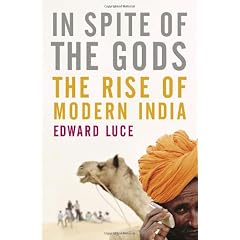
IN SPITE OF THE GODS


IN SPITE OF THE GODS
The Strange Rise of Modern India

By Edward Luce
Doubleday; 383pp; $26

The Good A graphic, and deeply personal, portrayal of India today.
The Bad The author's prescriptions for change are hardly profound.
The Bottom Line A balanced chronicle of the often contradictory dynamics that are driving the country.

James Paul, 29, is emblematic of India's new dynamism. The son of lower-middle-class Christian schoolteachers from the southern state of Kerala, he is a graduate of the elite Indian Institute of Technology in Mumbai. His parents were forced to take out a loan to fund his $120-per-term tuition. It paid off: Paul now manages a 1,500-person business unit at Bangalore software giant InfoSys Technologies Ltd. (INFY ), where he was hired in 1998. His salary has jumped tenfold in a decade, to $50,000, a huge sum given the area's low cost of living.

India, as anyone who hasn't had his eyeballs permanently affixed to a Sony PlayStation knows, is an economic juggernaut. In 2005, while launching its first bank in the country, General Electric Co. (GE ) projected double-digit revenue growth in Indian banking far into the future. "No one blinked," observes author Edward Luce. But weighing against GE's glowing assessment is the nation's widespread poverty: More than 300 million people live in squalor in the country's 680,000 villages, where both land and water are in short supply. Many homes are made with buffalo dung and feature charcoal hearths whose fumes worsen the symptoms of a prevalent disease, tuberculosis. Only 65% of the population can read, and in the villages that number falls as low as 33%. (China's literacy rate is 90%.)

source: businessweek